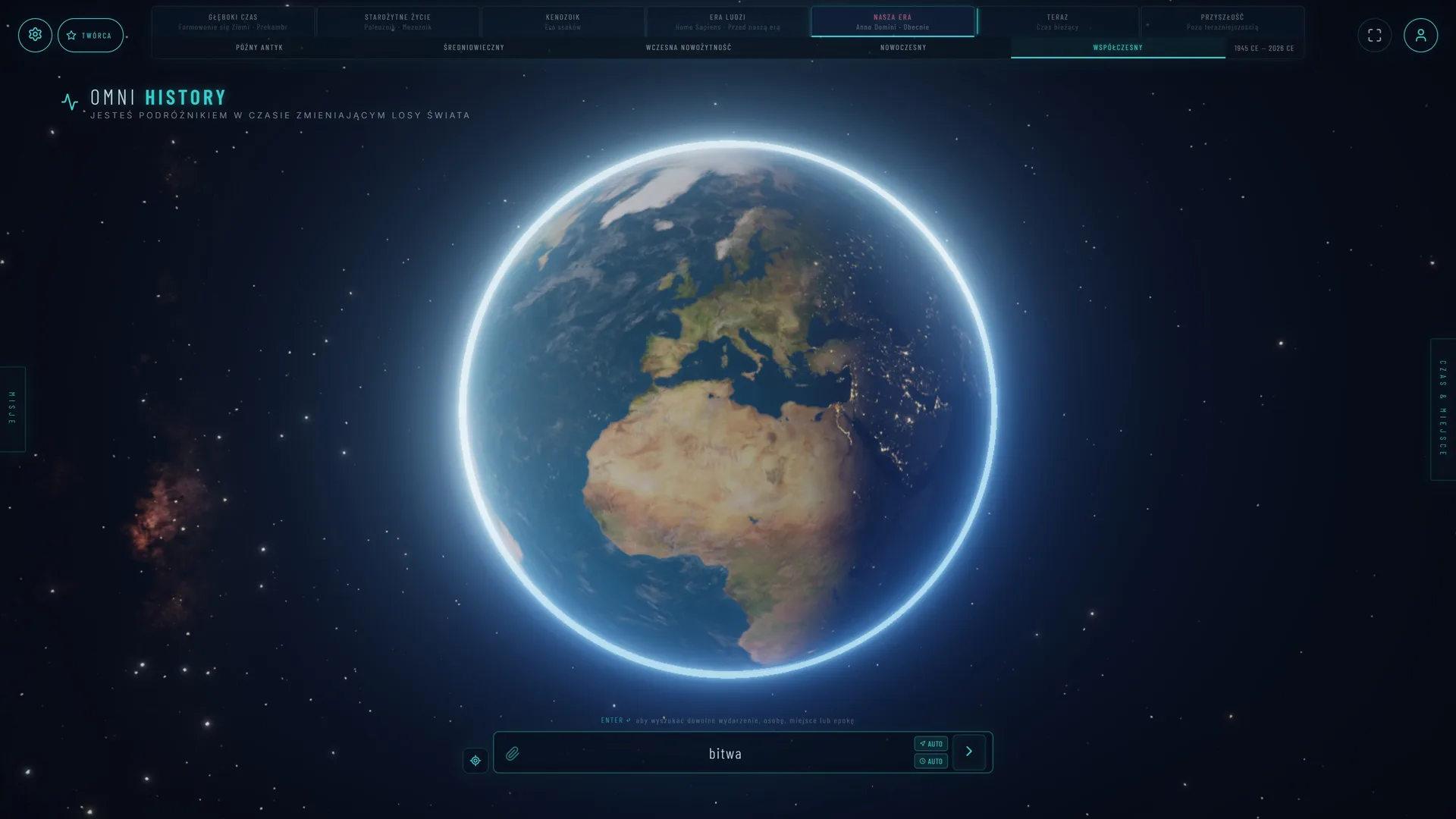
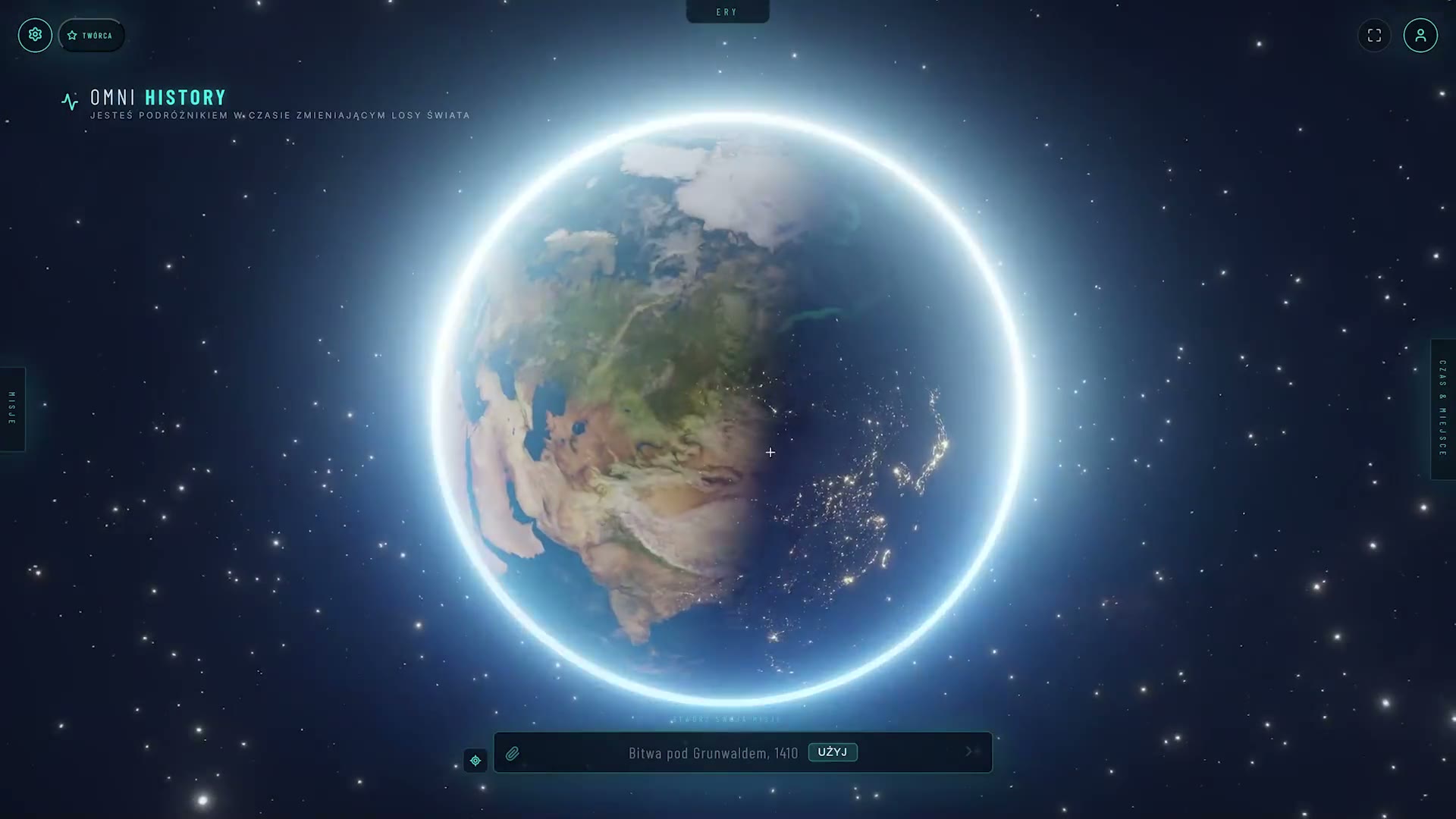
OmniHistory — photorealistic 3D globe with the era timeline
AI experience engine for history · closed alpha

OMNI
HISTORY

Step into any era. Change what happens next.

A photo, a letter, a map or a textbook page becomes a world you can enter. You stand where the picture was taken, the year is set, and the next decision is yours. History reacts — while every scene stays tied to its sources.

Runs in the browser · Polish and English narration · built in Gdynia, Poland

Explore
4.5B
Years of history
7
Playable eras
9+
Languages with narration
16
Live knowledge sources
4K
Scene resolution
See it in action

Two minutes inside a mission

From a blank prompt to a first-person scene with real references, a narrator and a decision on screen. Recorded on the alpha build.

OmniHistory demo video

Sound on. Scenes, narration and images in the video were generated by the engine from a single prompt.

Three ways in

Explore for free. Create with your key. Publish as an institution.

Finished paths can be generated in advance and reviewed by their authors. Visitors replay saved scenes; a new language may need an initial translation or narration pass. Creators use their own API keys. Institutions get editing, provenance and publication controls.

🌍
Explorer
Free

For visitors, students and the curious. No account, no key, no waiting.

  • Interactive 3D globe with the full era timeline
  • All published missions — an interactive film you steer by choices
  • Official accounts receive an additional ranking signal
  • Story tree view — jump to any node of a finished path
  • Narration and subtitles in your language
  • Mission trailers you can share as a link
  • Works on phones — sensors move your head
Saved scenes do not need to be generated again. Translation, new narration and hosting can still have a cost.
Creator
BYOK bring your own key

For streamers, teachers, writers and friends on a Saturday night.

  • Type anything: a battle, a street address, your own name
  • AI resolves time and place, researches, renders 4K scenes
  • Difficulty, checkpoints, player age, art style, genre
  • Consistency Chronometer shows how far you drift from history
  • Autonomous builder finishes the whole decision tree for you
  • Film studio: trailer + voice-over for every mission
  • Publish public, unlisted or private — authorship on every branch
Cloud or local models. Check the estimate before generation: resolution, scene count, narration and video affect the total.
How a mission is born

From one sentence to a world in seven steps

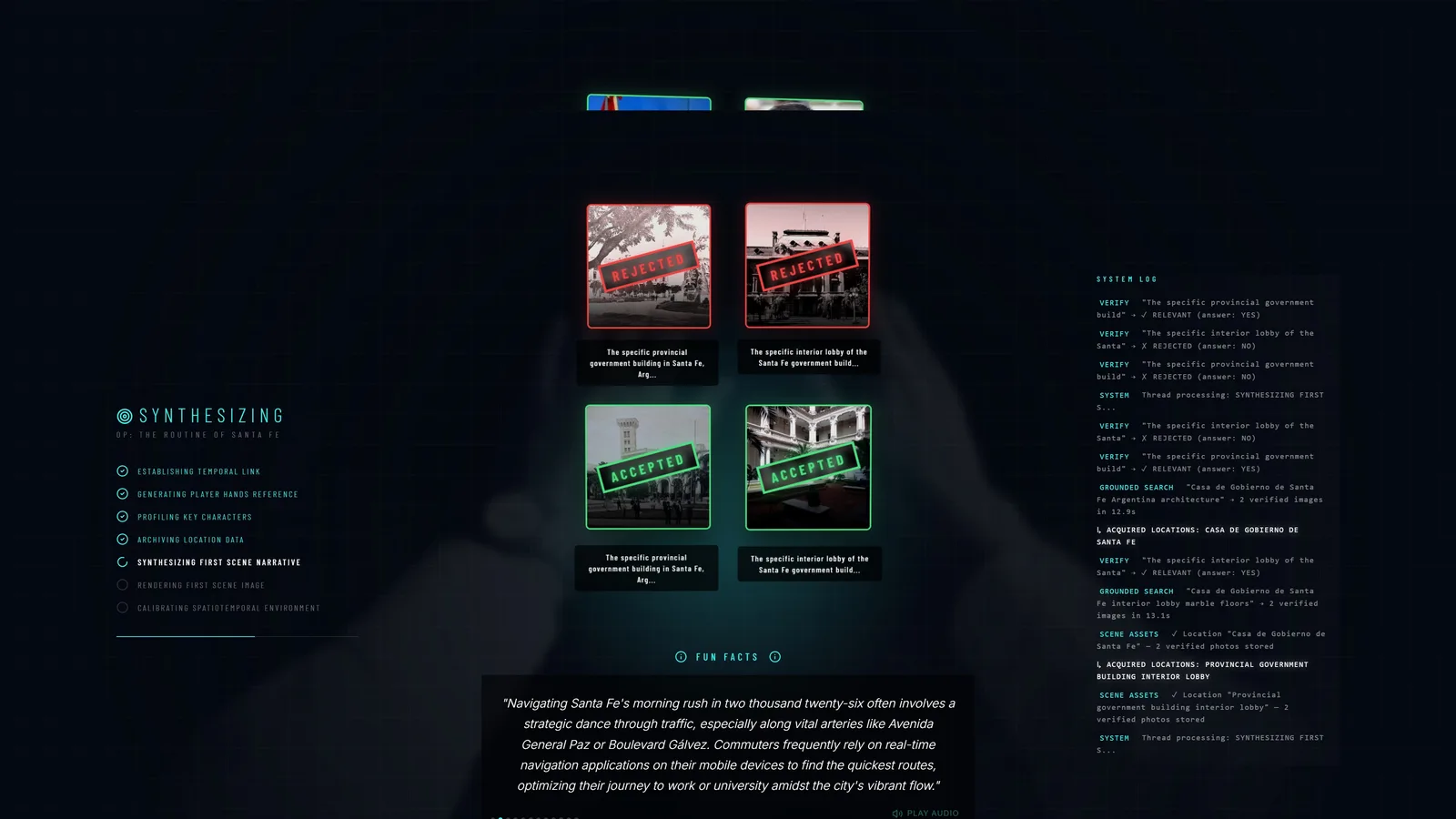
The player sees a synthesis screen with accepted and rejected references, a live system log and fun facts about the place and time — so the wait itself teaches something.

01

Temporal link

The prompt is resolved into a time window and a point on the globe.

02

Player hands

A first-person visual anchor: who you are, what you wear, what you hold.

03

Characters

Historically grounded people you will meet — profiled before the first scene.

04

Location archive

Street-level imagery and reference photos are fetched and verified one by one.

05

Narrative

A first-person scene with choices and mission goals as checkpoints.

06

Rendering

4K scene images, narration and ambient sound for the era.

07

Calibration

Sun position, weather, time zone and the era's atmosphere applied to the scene.

Mission synthesis screen — references accepted and rejected, system log, fun facts

Synthesis view: references are accepted or rejected in the open, with a log you can read.

Then the tree keeps growing on its own

Define the endings you want, the number of choices per step and a budget. The autonomous builder runs on the server and fills the whole decision tree — typically within minutes — with a main path, side branches and a controlled number of dead ends. Close the browser; it keeps going and resumes after a restart.

Every branch remembers who made it. A published mission can accept new branches from other creators — with the author's authorisation and a notification.

What is inside

Explore the alpha’s tools and the next steps

Built in five months of nightly builds — over 680 production deployments so far.

🌐
Living globe, deep-time timeline
From the Hadean to the year 10,000 — the whole interface re-themes with the era.

Seven major eras and thirty-plus sub-eras. Click any point on Earth to get the place name, local time, time zone and weather for that moment, then travel there.

  • Day/night terminator, city lights and clouds computed for the chosen date
  • Tectonic warp: continents drift into position as you scrub through geological ages
  • Chrono-scrub with year, month, day, hour and minute precision
  • Keyless satellite imagery with a fallback provider
🧭
Consistency Chronometer
A live 0–100% reading of how far your story drifts from recorded history.

Every step is scored against what actually happened. Order a bust of Lenin in a Minsk office and the chronometer drops toward zero — you are told, in the open, that you are now in fiction. Two modes: historical keeps you on the rails, speculative lets you go off them knowingly.

  • Paradoxes have consequences: sabotage something that historically had to survive and the mission can end
  • Missions are also scored for historical, educational and entertainment value (0–100)
  • Official status is one of several ranking signals in Explorer
🌳
Branching story tree
Two, three or four choices per step. Many endings. A visible map of all of them.

The story is a graph, not a script. In Explorer you can open the tree and jump to any node of a finished path; in Creator you decide where it grows next.

  • Autonomous builder completes the tree server-side within your budget
  • Time windows: a mission can span decades and jump between key decisions (1937 → 2012)
  • Dead ends and victories are limited by design, so trees stay finite
  • Authorship is recorded per branch; foreign roots are rejected on merge
📚
Grounded in sources
Sixteen live knowledge tools and a provenance record for every reference.

Scenes cite where their facts and pictures came from. The engine queries encyclopaedias, museum and archive APIs and open image collections, prefers permissive licences, and stores the origin of every reference so an institution can contact the rights holder or swap the asset.

  • Sources chip on every scene; full audit view for editors
  • Requests are proxied server-side with SSRF protection — your key never leaks
  • Fact basis and photo source are stored with the scene, not in a prompt
🖼️
Scene editor and segmentation
Change the uniform, add a crown to the eagle, keep the rest of the frame.

Select an object in the scene, give an instruction, re-render. Segmentation runs on our own server (no GPU needed), edits keep a history you can undo, and reference images can be attached without a limit.

  • Pins, brush and speech-bubble annotations anchored to the scene
  • Lossless editing path — the original frame is never degraded
  • Built for the curator who has to satisfy a review board
🎬
Film studio
Every mission gets a trailer with a voice-over you can share as a link.

A director model writes the shot list, scenes are animated, a narrator reads the hook and music is mixed underneath. The link opens full-screen, on phones too, and ends with a button into the game.

  • Fallback camera moves when a shot is rejected by moderation — never a hole in the film
  • Volume normalisation and ducking so narration always sits above the music
🗣️
Live translation and narrators
A mission written in Polish plays in English — with an English narrator.

Missions are translated on the fly and cached per language, so the second visitor gets it instantly. Narration is generated per language with matching voices; subtitles follow.

  • Nine-plus interface languages; mission text in any of them
  • Fun facts read aloud while a scene loads
📱
Phones, laptops, big screens
Most people arrive on a phone. The mission view was rebuilt for that.

On mobile, the phone's sensors move your head inside the scene; swipes navigate; touch-look is the fallback. On desktop the interface scale is a setting, so text is readable on a 13-inch laptop as well as a wall display.

  • Deep links: any scene of any mission has a URL
  • Kiosk mode for on-site touch screens is in preparation
🚀
Beyond Earth
Orbit, other planets and imagined realms — with real astronomy underneath.

A mission can leave the ground. Each scene has a realm — Earth, orbit, a planet or a place that never existed — and an algorithmic ephemeris positions the Sun, Moon and planets for the chosen date.

  • Sample paths: the end of the universe, trilobites under a dying sun, a speech in Washington, 1963
📖
Textbook to mission
Photograph three pages of a history book. Press Enter.

Reference images can be screenshots, scans or phone photos of physical pages. The engine reads them and builds the lesson as a playable story — ancient Mesopotamia from a first-year textbook, in first person, with quiz-like decisions.

  • Player age and difficulty tiers shape vocabulary and stakes
  • Realistic or illustrated art style — Little Red Riding Hood for a five-year-old works too
🛡️
Safety and moderation
Visibility and branch approval now; broader moderation is planned.

The alpha has private, unlisted and public missions, source audits and approval of contributions to official missions. Player age guides generation; it is not an independent safety certification. Automated pre-publication age checks and a documented likeness-consent workflow are planned safeguards.

  • Public, unlisted or private missions
  • Server-side sessions; identity is never trusted from the client
  • Production request limits, isolated API keys and source-audit records
💡
Fun facts, trivia, news
The loading screen is a lesson. The present day is a live feed.

While a scene renders, the player reads and hears facts about the exact place and moment — preparing them for the decision ahead. In the "Now" era a geo-tagged news feed shows what is happening at the pin today.

  • Editors can write their own trivia for a mission
  • Quizzes between steps with rankings are on the roadmap
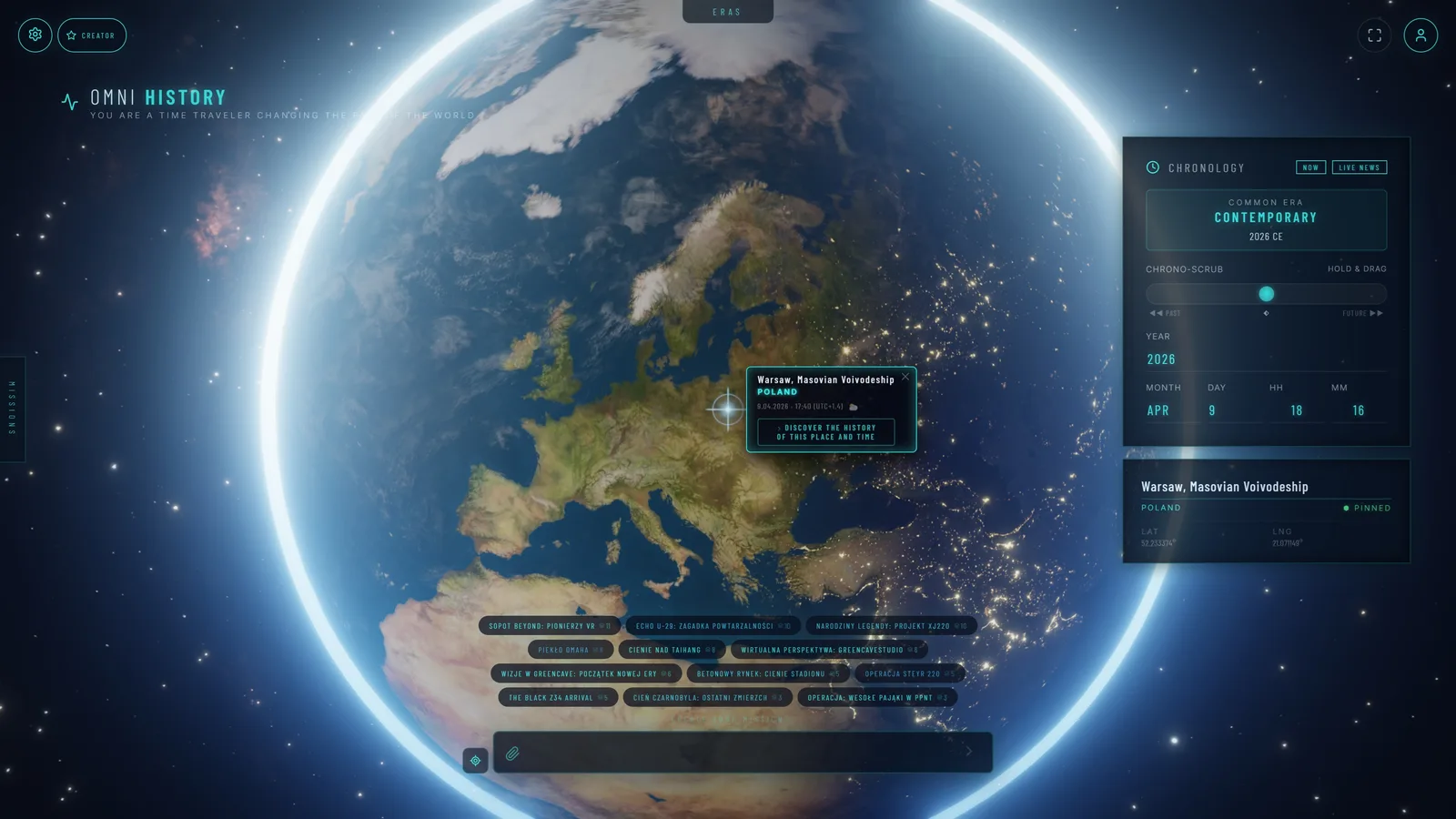
Chronology panel with chrono-scrub and a pinned location

Chronology panel: pin Warsaw, scrub to 1944, or to 2126.

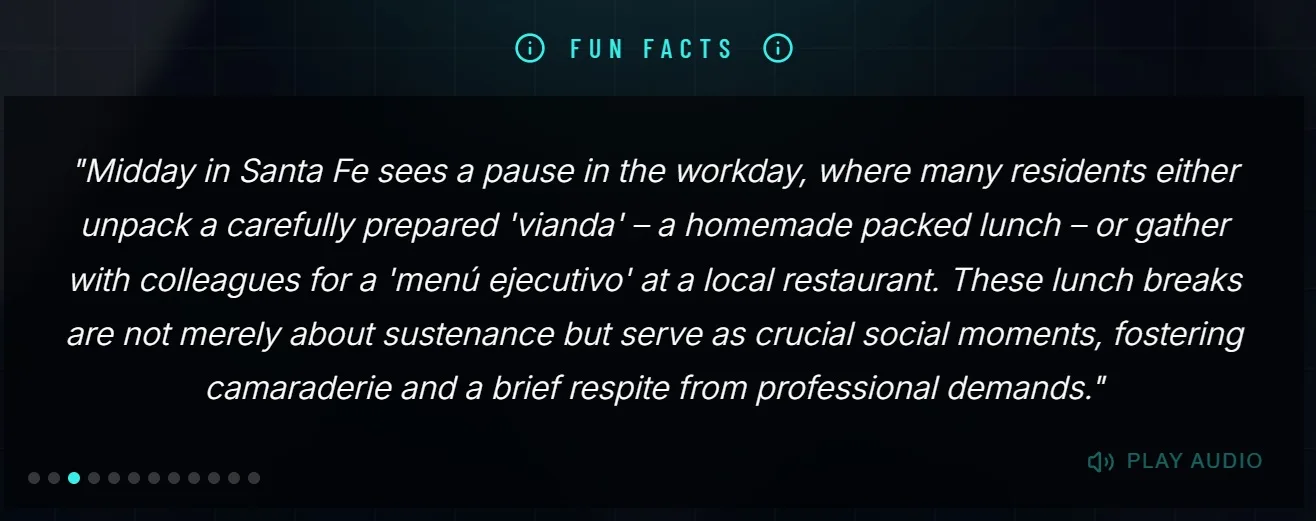
Fun facts shown while a scene loads

Fun facts about the place and moment, read aloud while the scene loads.

For museums, schools and publishers

Every archive is a treasury. Most of it never becomes an experience.

A photo in a display case, a letter in a drawer, a caption on a wall. Turning one archive into a good interactive exhibit today takes a curator, a writer, a designer, a researcher, a developer and five tools. OmniHistory collapses that into one workflow — and keeps the curator in charge of facts, sources, rights and publication.

  1. Upload the sources

    Photos of exhibits, letters, maps, textbook pages — taken with a phone on site if you like.

  2. The engine builds the world

    Narrative graph, scenes, characters, decisions and alternative paths — hundreds of possible passages, generated once.

  3. The curator decides

    Correct text and images, inspect source licences, choose mission visibility and review contributions before they reach visitors.

  4. Visitors step in

    In a browser, on a phone or on a gallery display. A prepared path can be replayed without regenerating its saved scenes.

What the visitor actually feels

It is 1939. You stand where the photograph was taken. Follow events or try a different choice. History reacts. The source trail and consistency indicator help you examine where the reconstruction draws on evidence and where interpretation begins.

Tested with children: the fun was not watching the story — it was deciding what happens next. Waiting for the next scene only raised the tension.

Museums Schools Textbook publishers Cultural institutions Universities Corporate training
Book a demo with your materials →
Economics: a costly multi-person project becomes a repeatable workflow and an annual software licence. Generation is paid once, at authoring time; the exhibit then runs for years.
"The most valuable asset of a museum is not the building. It is the stories hidden in thousands of photographs, letters, maps and documents." — from the OmniHistory stage pitch, September 2026
Why this is hard to copy

A model generates a picture. An engine keeps a promise.

Generative models get better every month — and all of them can be plugged in here. The value is in what sits around them.

🧾

Provenance by default

Scenes preserve reference sources and generation history where available. Curators can inspect and correct them; an official badge identifies the account, not a guarantee of accuracy.

🧑‍⚖️

Curator-in-the-loop workflow

Edit scenes, control visibility, approve contributions and publish deliberately — these are tools, not just instructions in a prompt.

🕸️

A growing library of published paths

Each institution that publishes makes Explorer more valuable for the next one. The content network compounds; a single model does not.

🔌

Model-agnostic pipeline

The engine integrates several text, image and video providers, with local options for selected tasks. Provider availability and capabilities differ.

Roadmap

Shipped, in progress, next

The alpha is live at a private address. Institutional pilots decide what gets built first.

Shipped in the alpha

  • Globe, 7 eras, chrono-scrub, tectonic ages
  • Seven-step mission synthesis with reference verification
  • Branching trees and the server-side autonomous builder
  • Consistency Chronometer and mission scoring
  • Knowledge tools, provenance audit, licence policy
  • Scene editor, segmentation, annotations
  • Film studio with narrated trailers
  • Live translation and per-language narrators
  • Mobile mission view, deep links, space missions
  • Official accounts, visibility, branch authorisation

In progress

  • Institutional pilots — first demo missions built from a real site's materials (a WWII coastal battery, a university history department)
  • Chrono Bridge — a connector between missions: your traveller carries statistics and decisions from one world into the next
  • Kiosk mode — a branded time-machine terminal for galleries, running Explorer paths offline-first
  • Readability pass — larger type and a laptop-first layout after feedback from early viewers
Questions we get

Straight answers

Is it free?
Exploring published paths does not require your own API key. The alpha is currently invitation-only. Creating content uses model-provider API keys; institutional licensing is discussed individually.
What does one mission cost to generate?
There is no single price for a mission. The alpha shows an estimate before generation, based on the model, resolution, scene count, narration and films. Model retries and additional edits can raise the cost. Saved scenes can be replayed without generating them again.
How historically accurate is it?
Accuracy depends on sources and human review. Research references and the Chronometer help with checking; an AI score is not proof of historical truth. Official accounts have editing and branch-approval tools, and remain responsible for their published material.
Can someone generate something harmful and stream it?
Generative models can make mistakes and produce unsuitable material. The alpha offers private drafts, publication controls, source review and branch approval. Automated age classification and a likeness-consent workflow are still planned. Review the complete path before sharing it with a class or an exhibition audience.
Which languages?
The interface is available in nine-plus languages. Missions are translated live and narrated in the viewer's language, with the translation cached so the next viewer gets it instantly. Polish and English are the most tested.
What do I need to run it?
A browser. It runs on a phone, a laptop with integrated graphics or a gallery touch screen. Segmentation and the autonomous builder run on our servers in the EU (Frankfurt); no GPU is required on your side.
Can I bring my own materials?
Yes — that is the point. Photos of exhibits, scanned letters, maps, textbook pages, even a screenshot of a listing. They become references the engine must respect, and they are recorded in the audit trail.
Who owns what is created?
Authorship is recorded per branch. Mission owners choose visibility and official owners can require approval of new contributions. Rights to uploaded materials and necessary permissions must be checked by the publisher.
Where does the name come from?
Omni — every place, every time. On Earth everything is perfectly normal; the odd things happen only on the Bridge between missions, and that is a story for the roadmap.
Closed alpha · by invitation

Bring a photo. Leave with a world.

Write to us for early access, an institutional demo with your own materials, or a partnership conversation. We answer personally.

Request early access Partnership

Or simply: lazniak@hexart.pl